Following last week’s adventures in carbon footprinting, I thought it might be good to run through the things that make the biggest difference.
There’s a lot of misinformation out there. Plastic bags, for example, keep coming up in the context of climate change. Plastic bags represent 1/5000th of an adult carbon footprint. They need to be banned, but not for the climate. Turning appliances off properly, unplugging chargers are good ideas, switching to low energy light bulbs, etc, are all good ideas. But I expect you already do those, if you’re here reading this. And I bet it hasn’t made a serious dent in your footprint. Take every recommended action at the end of Google’s carbon calculator, and it’ll knock less than half a tonne off your annual co2 – not insignificant, but nowhere near a sustainable level.
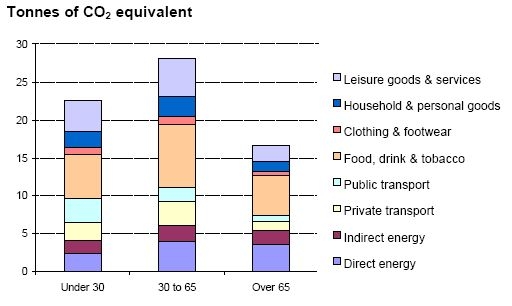
So if the top tips won’t save us, what will? Let’s look at the government statistics on household co2. Here’s the pdf. The carbon calculators all deal with individual co2, but the best figures I’ve found relate to households, and the subject is better tackled by household anyway. Depending on your age, this is where your greenhouse gas emissions come from:
Food
The first thing you might notice is that the largest factor here is food, drink and tobacco. Which is interesting, because in the 8 calculators I compared, only one mentioned food in any detail.
The biggest contributor to this figure is meat. I’ve said it plenty of times, but it’s one of the biggest oversights in the climate change debate – lifestock is responsible for more greenhouse gas emissions than the entire global transport network. These are methane emissions, which perhaps explains why they don’t get counted, but methane is worse than co2 for global warming. All told, lifestock accounts for 18% of greenhouse gas emissions.
Beef if the big one. One kilo of beef is as damaging to the environment as driving your car for 160 miles. So, if you’re seriously looking at bringing your footprint down to size, meat is one thing that really makes a difference. As with all these things, you don’t have to stop altogether. Just eat less meat. Make beef the luxury it always has been. Save it for special occasions, and when you do eat beef, eat grass-fed, free range beef. It’s much better for animal welfare. (It can have lower emissions than feedlot beef too, though this totally depends on where you are in the world. In the US feedlot beef has lower emissions). The stuff to cut out is the cheap beef, the McDonalds or the ready-meal lasagnas, where the meat has no real taste anyway.
Veggies don’t get away scot free here either, because there are plenty of emissions around vegetables. Because supermarkets operate on a ‘uni-seasonal’ basis, fruit and vegetables are available all year round, and have to be shipped or flown in. We’ve talked about air miles elsewhere, so I won’t labour the point here. If you want to tackle this one, look at eating more seasonal food. I set myself the challenge to do just that this year, and it’s been no challenge at all. Here’s what’s in season right now, by the way.
Lastly, the emissions from food and drink go up with the distance it has travelled, but also with the amount of processing involved. Processed food, of any kind, always has higher emissions than fresh food. That will include shipping to sorting houses, factories, and packing plants. It’ll involve the energy to run machines, the emissions of all the ingredients travelling from elsewhere before they’re combined. Eating for the planet means eating fresh food. And that’s no hardship, since it’s tastier and better for you anyway.
Household energy
At the bottom of the graph above you’ll see energy use, both direct and indirect. Direct energy is what you’re using in your home. Indirect energy is that which goes towards generating the power you use. Power stations are notoriously inefficient. Some 60% of the fuel that goes into a power station is wasted in heat. This is because heat doesn’t travel well, and nobody wants a power station in their back garden. The stations are too far away from the homes where the electricity is used, so the heat is just vented into the atmosphere rather than put to use generating further power, or heating homes.
Your direct household energy use is easier to bring under control. The most important thing here is not light bulbs, it’s insulation. A third of the energy spent on heating is lost through the walls and roof. Loft and cavity wall insulation make a big difference, and can knock hundreds of pounds off your bills as well as your footprint. It makes no sense not to insulate your home properly, but still, 40% of homes have no loft insulation. Half of those who haven’t done it are put off by the cost, seeing the outlay rather than the eventual savings, despite the fact that it would pay for itself in less than five years. Worse yet, 60% of people who haven’t done their lofts say they haven’t because they can’t face the accumulation of junk that’s up there. Like eating fresh, seasonal food, household energy is one of those things with obvious benefits beyond co2, and we should pay more attention to it.
One other thing I’ll mention here – smart meters. The government is making meters that show real-time power use a big part of their plans for reducing household emissions. The idea is simple – a smart meter displays real time energy use, so you can switch on the kettle and see exactly what it costs you. You can switch everything off and see how much power is still being used. Using a smart meter can knock 10-15% off your electricity bills almost instantly, but a survey last November showed that only one in five people had even heard of smart meters.
Consumption
Consult that bar graph at the top again and consider the impact of your shopping. We all know we’re supposed to be using our cars less and riding bikes and so on, but ‘leisure goods and services’ account for more co2 here than private transport. Add on clothing and footwear, and household and personal goods, and you’ve got 25-30% of our emissions from consumption. None of the 8 carbon calculators I tested factored this in.
Most of the emissions from consumption are indirect, but we’re still responsible for them. If I buy a new t-shirt off the high street, I am adding a long chain of emissions to my account, from the farm machinery where the cotton was grown, to the plant where the cotton was processed, the sweatshop where the shirt was sewn, the trucks and ships that brought my shirt from China, through to the shop where the shirt was displayed and bought and driven home. We underestimate the emissions behind our consumer choices. 36% of global emissions are from the manufacturing industry.
Other things included in this leisure services category would include books, newspapers, watching TV, going to the theatre, enjoying sport. To reduce emissions here we can enjoy things that are free, participating in local sport, enjoying the outdoors. We can play games and enjoy good old fashioned conversation.
Household and personal goods includes pharmaceuticals, cleaning products, and appliances. If we want to reduce our footprint in this area, we need to do things like buy secondhand, fix things when they break rather than replace them, share things rather than always having our own, buy less and buy better quality.
Conclusion
So, there are three things that will make a big difference to your carbon footprint. Yes, stop flying. By all means take up cycling, change your lightbulbs and wear a sweater. But first, cut down your meat eating, insulate your home, and just all round buy less stuff.
I don’t know why this kind of detail is unavailable on carbon footprints. Here’s one other one I found, a slightly different breakdown from the Independent. If you know of others that actually include the important things, let me know, and perhaps we can set some priorities straight along the way.
 The Earthbound Report
Check out this interactive US Carbon Footprint Map, an interactive United States Carbon Footprint Map, illustrating Greenest States to Cities. This site has all sorts of stats on individual State & City energy consumptions, demographics and much more down to your local US City level…
http://www.eredux.com/states/
Thanks for that one. It is possible to get to the point where you can tick all the boxes on the standard and much publicised life-style changes to reduce CO2 and be more eco-aware, and then wonder what to try next.
One of the big issues in consuming less meat is that for decades we have been used to eating it as the centre-piece of a meal, to which vegetables are a some-what flavourless accompaniment. We need to do two things, I think;
*Regard the vegetables in their delicious diversity as the centre-piece, exploring their huge range of textures and flavours
*Re-educate our taste-buds. It is possible to learn to like almost anything (I know from experience!)
If you are hungry you appreciate food so much more, so cut out unnecessary snacking and anything can be a feast. Take the trouble to cook it for yourself, then you will really enjoy the sense of reward and achievement as you sit down to consume the fruit of your labours. And don’t make comparisons. It does not help if you are indulging in self-pity as a suffering hero while you pick at your veggie meal,wishing all the while it was an 8oz steak. Try instead to learn to appreciate different flavours and textures on their own terms, broadening your tastes as you do so. Believe me, you will enjoy your food so much more, and you will very likely consume much less!
I read in George Marshall’s Carbon Detox book that long-haul flights are the first thing you should quit to get your carbon levels down… that flights are the biggest contributor to carbon emmissions. I don’t have the book to hand but that’s the main impression I got.
Simply cutting down meat consumption as an individual is surely going to cut less carbon than, for example, choosing not to fly to Australia? Or have I got that wrong?
On an individual level, yes, that’s probably the case, but only if you’re a serial flyer. Many people don’t fly – it’s more of a middle class thing. Across the whole country, emissions from aviation account for around 7% of emissions.
So, if you’re talking to the middle class specifically, stopping our flights is one of the first things to do. As a strategic priority nationwide, insulation, diet and consumption account for more actual CO2.
However, aviation gets the headlines because it is the fastest growing source of emissions, and something the government has been encouraging. Because flying is such a carbon intensive activity, growth in aviation would be disproportionately damaging and make our CO2 targets unreachable, so it is important from that point of view.
Excellent article with a pragmatic attitude with one small criticism. Although I am no expert I just cannot imagine how grass fed, free range beef will be less environmentally damaging than it’s intensively farmed counterpart, especially with regards to its carbon footprint. Beyond the over-use of antibiotics, the use of human grade feed and the obvious animal welfare aspect it seems to me that intensively farmed beef will have a significantly smaller carbon footprint. Of course the message remains the same…eat less red meat!
Yes, the inclusion of grass-fed beef is not because it’s lower carbon, but because of animal welfare. Eat it very occasionally is the message – and when you do, eat the good stuff.
Jeremy, I appreciate the sentiment but it does explicitly say in the article that grass fed cows are “…better for animal welfare, but also has lower emissions.” I may be being pedantic but I cant see how that is accurate and throw away comments like that tend to damage the perceived validity of such useful articles as this.
At the time of writing grass fed beef was considered better, so it wasn’t a throwaway comment. The article I linked to in that paragraph has the statistic from a 2003 study.
That was a while ago though, and studies carried out since paint a much more complicated picture. It really depends on where you are in the world and how good the pasture is.Grass fed cattle might have lower emissions in places like Sweden or Ireland, but feedlot cattle has lower emissions in the US, Australia or Brazil.
I’ve amended the post to reflect this. It’s impossible to keep on top of archive posts and update them, but I agree with you that accuracy matters and thanks for pointing stuff out!